
Will your practice actually support the life you want to live?
The Functional Membership Practice Patient Growth Simulator turns that question into real numbers. Model your practice exactly as it is today, take a baseline snapshot, then change a few things and watch what happens — before you ever risk it in real life.
Not circles on a whiteboard. Not gold-silver-bronze guesswork. A working simulation of your membership practice.
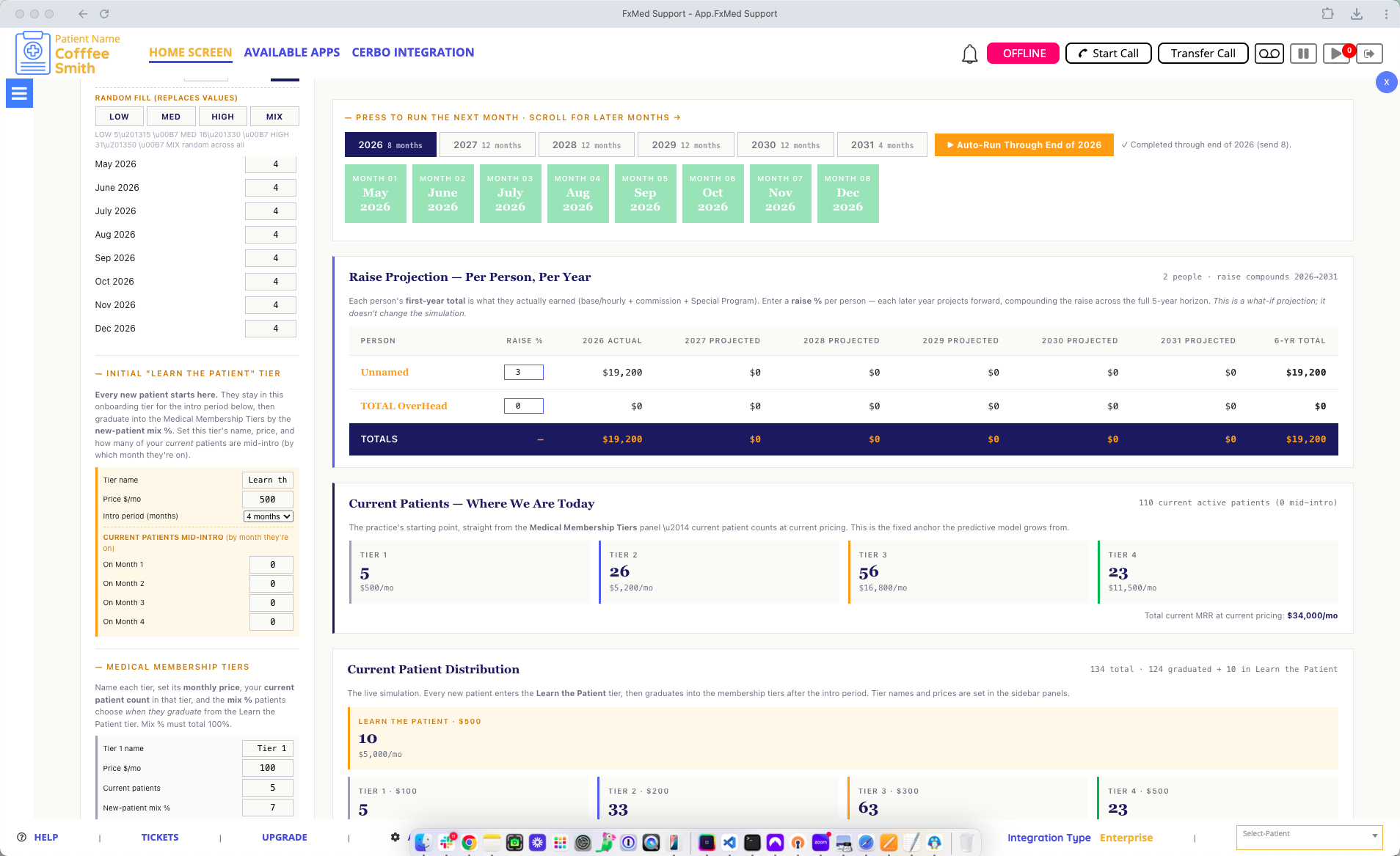
Most membership models are built on a whiteboard.
Gold, Silver, Bronze. Three tidy boxes drawn before a single patient walks in the door. The trouble is that real patients don’t fit tidy boxes — and the math underneath was never tested.
One patient has one set of labs. Another has ten. Bill them the same, and one of them is quietly destroying your margin.
Functional and integrative practices need a model built around the patient — their illness, their complexity, their resource load — not a price sheet designed in a vacuum. And they need to know the financial picture before they commit, not after.
Start by learning the patient. Then build the membership around them.
Every new patient begins in a discovery phase — the Learn the Patient tier. It’s the onboarding and evaluation window where you order labs, build the treatment plan, and understand exactly how much support this patient will need. Only then do they graduate into a long-term care tier that fits their real clinical complexity.
Example pricing shown. Graduating patients don’t all land in the sickest tier — you set the new-patient mix (for instance 32% → Tier 1, 53% → Tier 2, the rest spread across Tier 3 and Maintenance), and the simulator validates every patient count balances before it will run a projection.
Every operational variable that decides whether the practice works.
The simulator doesn’t run on abstract assumptions. It runs on the real levers you pull every month — and shows you exactly where each one lands.
Patient progression
Current active patients, pending discovery patients, and graduation percentages into each care tier — tracked month over month as your practice grows.
Discovery appointments & conversion
Set how many discovery appointments you can book each month and your conversion rate. The model turns that into new-patient growth.
MRR, ARR & Net Position
Monthly Recurring Revenue, Annual Run Rate, revenue after payroll and overhead, and the owner profit that’s actually left over.
Capacity & pricing optimization
Define your desired full-practice size. As you approach capacity, the simulator shows why entry pricing should rise — and by how much.
Market size assumptions
Geographic market, virtual audience, and social-media growth. Model a local practice of 50,000 or a virtual reach of 100,000+.
Average revenue per patient
What each patient is actually worth, your revenue efficiency, and whether the financial picture is genuinely sustainable.

Staffing & compensation, modeled in full
Add unlimited staff — Main Provider, Office Manager, Medical Assistant, Virtual Admin, an RN, anyone. Then pay each of them the way you actually pay them.
Special programs — revenue beyond memberships
Layer in revenue streams that sit outside the membership tiers entirely. Name them, set the monthly income, and share a percentage with the staff who run them.
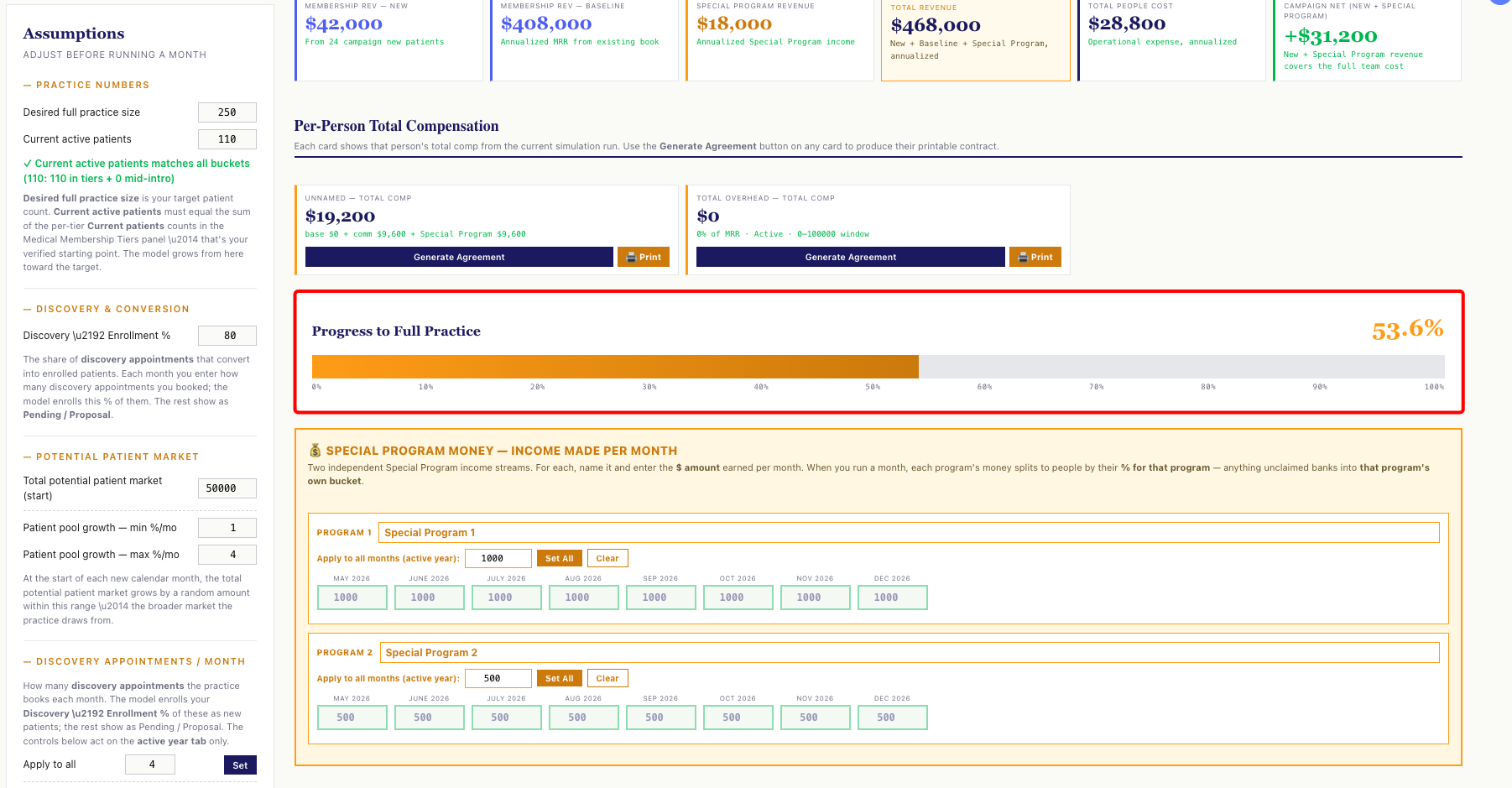
Snapshot. Adjust. Re-run. Compare the delta.
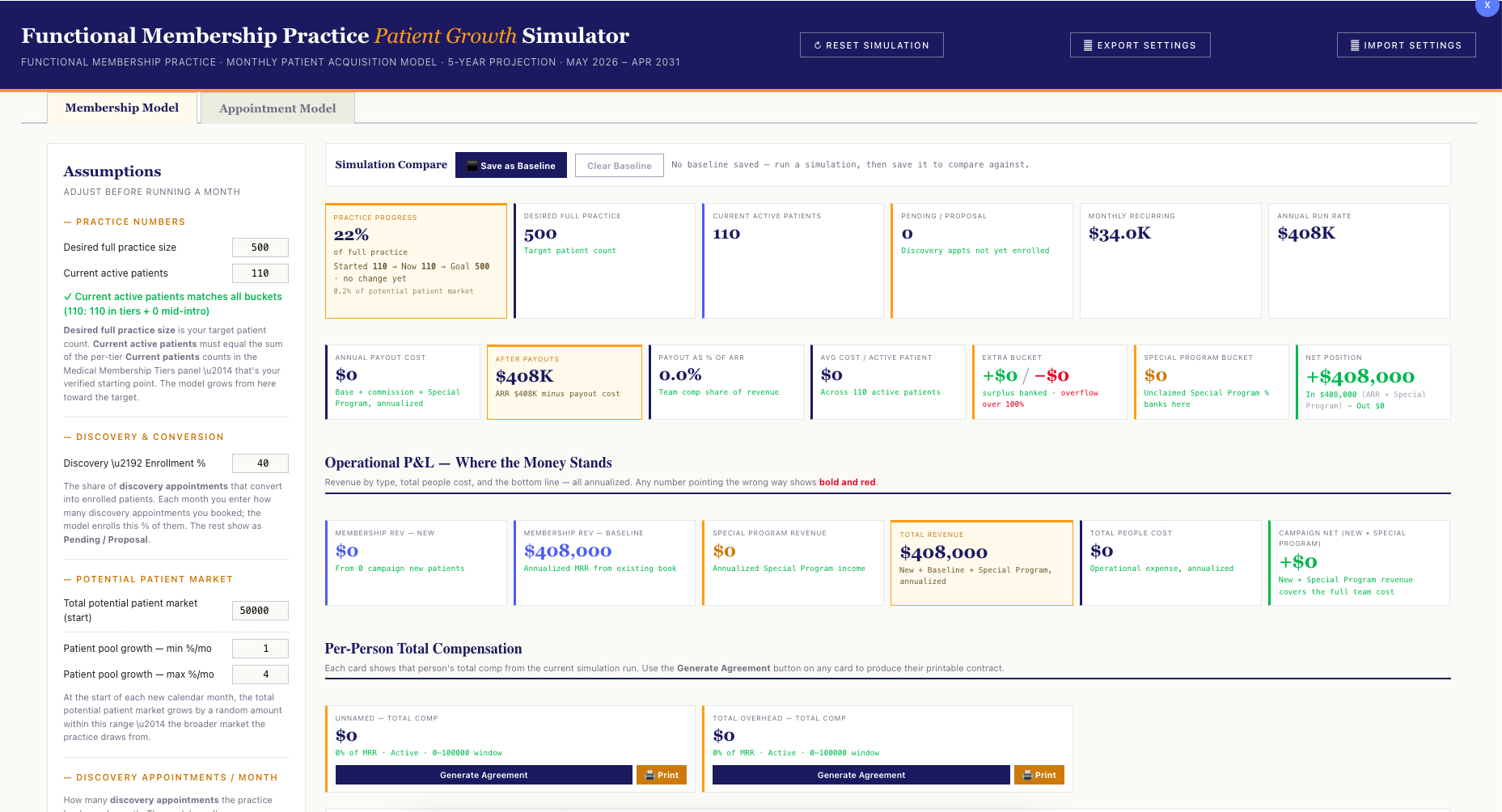
This is where guessing ends. Build your practice, save it as a baseline, change one thing, and the simulator shows you precisely what that one change did — in dollars, in patients, in years.
Build your practice
Patient counts, tier pricing, graduation mix, discovery volume, staffing, and special programs — configured to match reality.
Save a baseline
Run the projection and lock it in as your reference point — the “this is us today” snapshot.
Change one thing
Raise the Maintenance tier. Hire a nurse. Add a program. Push discovery volume. Then reset and re-run.
Read the delta
Side-by-side against the baseline — every metric that moved, and by how much. The highest-leverage adjustment becomes obvious.
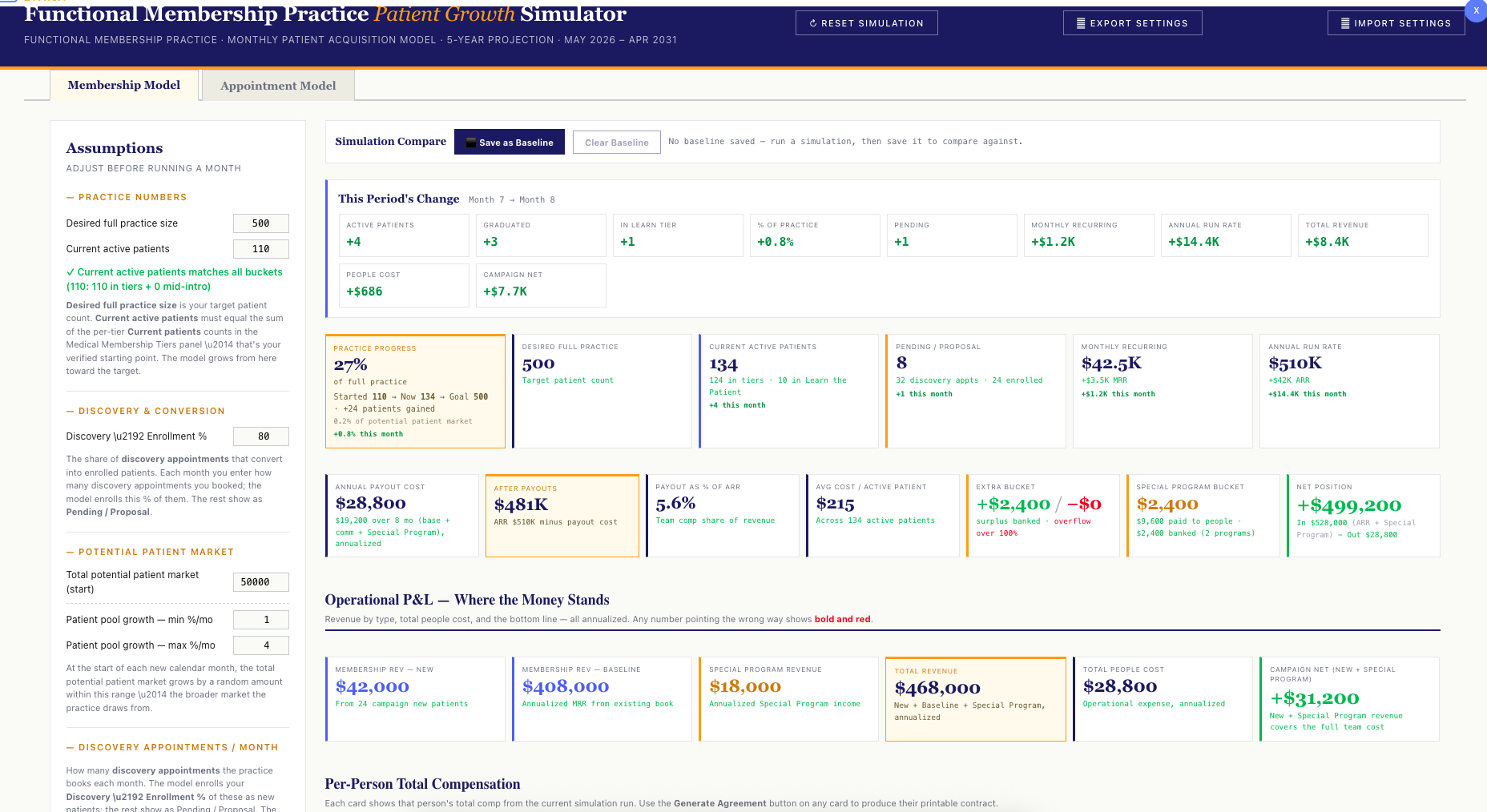
You no longer have to guess. You run true numbers.
In one example run — 8 leads a month, 80% conversion, a 300-patient target — the simulator projected past $1.2M in membership revenue, and flagged exactly where growth outran realistic capacity. Test it for 12 months or push it five years out. Either way, you see it before you live it.
Optimize. Integrate. Automate. Leverage.
The simulator exists to take the wondering out of running a functional medicine practice — and to let real data, not assumptions, drive the decisions that shape your life.
Optimize
Find the pricing, patient mix, and capacity that produce the most sustainable practice — not just the biggest one.
Integrate
Built on Cerbo — the system already knows your active patients. The simulator works from where your practice truly stands today.
Automate
Multi-year projections, payroll forecasting, and capacity warnings run themselves — auto-run a full year in a single click.
Leverage
Use Cerbo’s data and architecture to do something Cerbo was never designed to do alone — model the future of the whole practice.
Will your functional medicine program sustain the life you want to live?
Stop bending circles on a whiteboard. Put your real practice into a simulation, make the fine tweaks, and find the version of your numbers that gives you the life you’re actually working for.